For roofing and contractor companies with one owner who want to know where the money went.

Stop running your company off the bank balance

Trinity is a done-for-you finance team for contractors. In 30 days you know which jobs made money and what to set aside for taxes, without doing the bookkeeping yourself.

Book my free 30-minute call

Free call. No setup fee. Month to month, cancel any time.

app.trinity.ceo
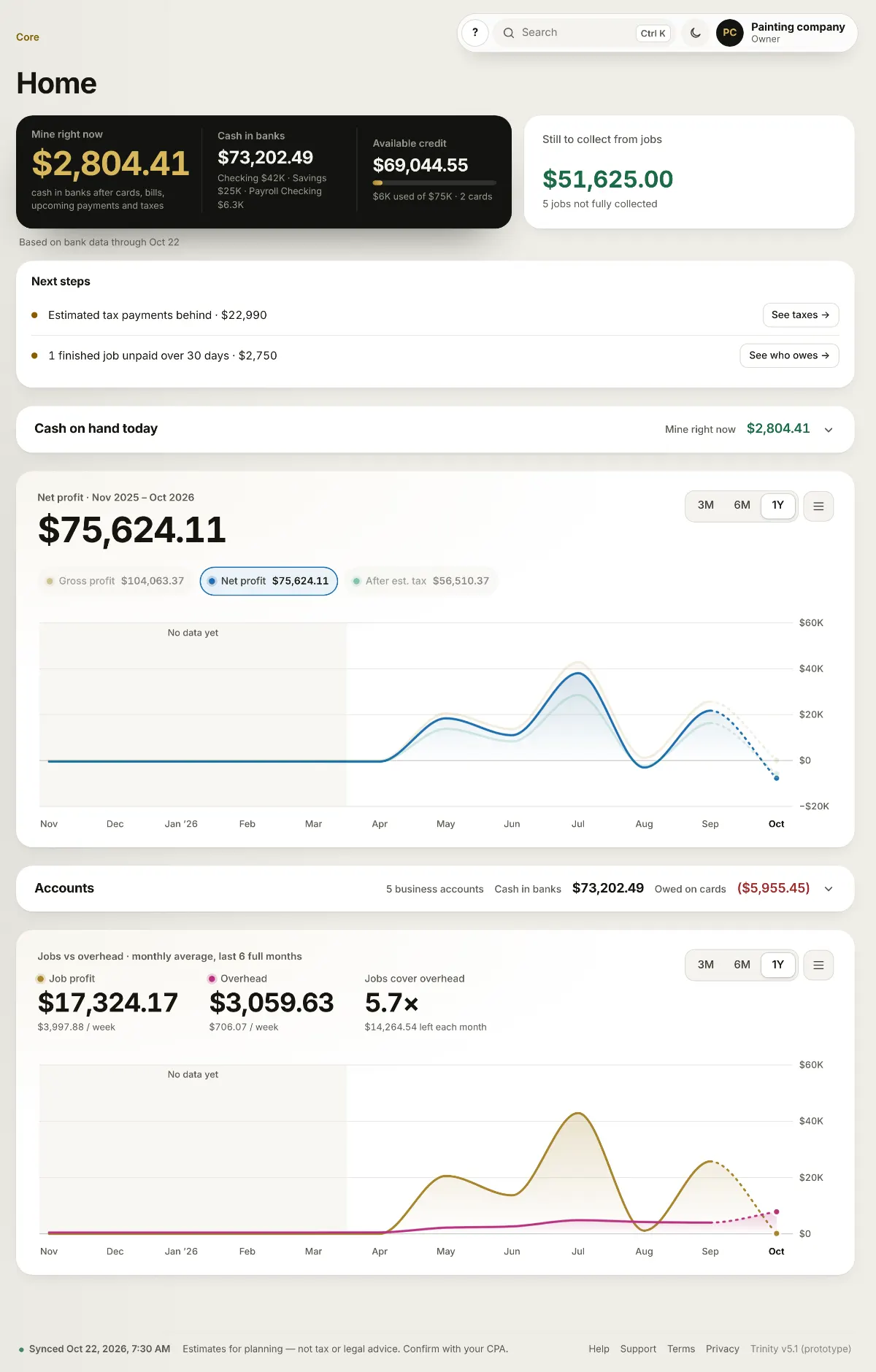
Trinity Home: cash that is yours right now, cash in banks, available credit, money still to collect and next steps. Example data.
P&L health score 88 out of 100, example data.

Real Trinity screens with example data for a fictional company.

Our first client, shared anonymously

$910Krevenue tracked in Trinity
67active jobs in one place
Autotax estimates, no spreadsheet

Roofing company, Georgia, 15+ employees. Individual result, not typical.

What is Trinity?

Your finance team, without hiring one.

Trinity is a finance platform plus a team that runs it for you. It lets you see profit, cash and taxes for your company without doing the bookkeeping yourself.

We get there by connecting your bank accounts, setting up rules for how your business works and checking every transaction each week... without you typing in receipts at night.

And as a result... you make decisions on real numbers, and you get your evenings back. That is what Trinity is for.

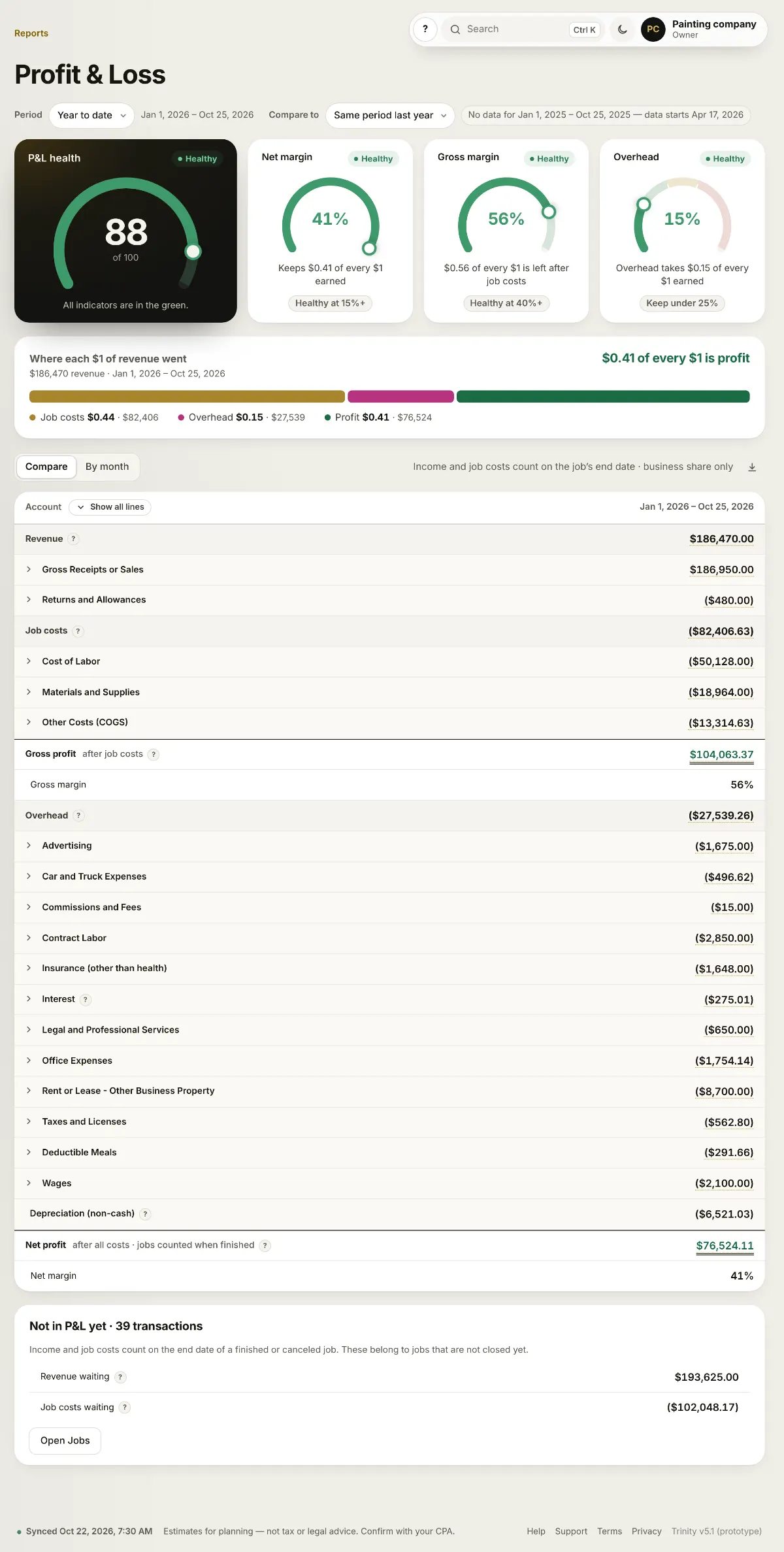
Profit & Loss

Did we make money?

Trinity Profit and Loss: health score and net margin, example data.

Cash flow

Where did the cash go?

Trinity Cash Flow: health score and overhead cushion, example data.

Taxes

What do I set aside?

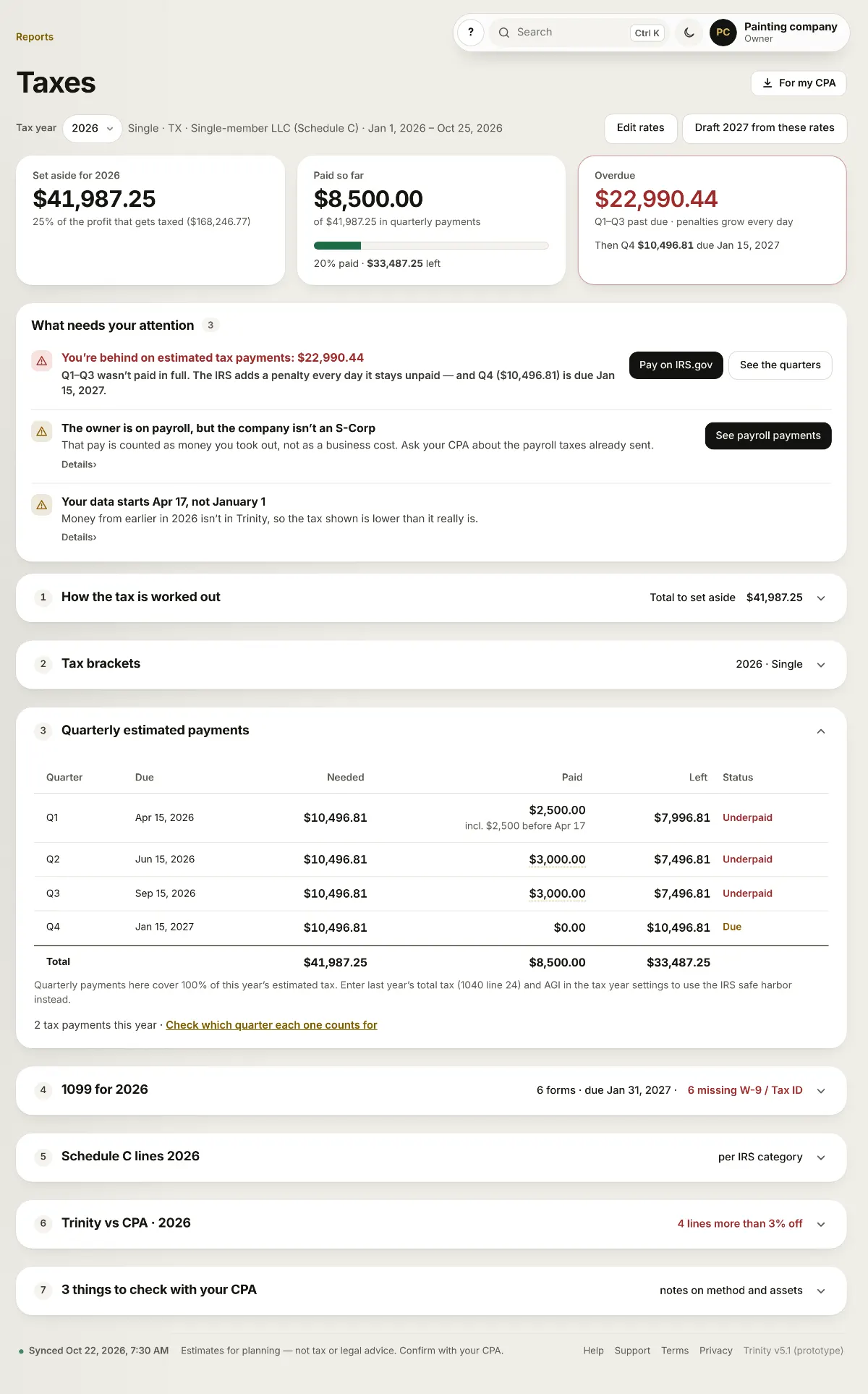
Trinity Taxes: amount to set aside for the year and amount paid so far, example data.

Real Trinity screens, example data for a fictional company. Tax figures are estimates for planning.

Why I built it.

Before I built Trinity, I worked as a finance director at a US virtual assistant agency.

Every day I was inside the books of American companies... reports, reconciliations, month-end closes.

And I kept seeing the same thing. Contractors with strong revenue who could not tell where the money went.

So I built the tool I wished they had. That tool is Trinity.

Dear roofing company owner,

From: Raim Yestayev, founder of Trinity

Re: knowing which jobs make money (and why your bank balance cannot tell you)

Would it surprise you to learn that our first client, a roofing company in Georgia, now sees $910K of revenue and 67 active jobs in one place... with tax estimates calculated automatically?

Client result, shared anonymously. Individual result, not typical.

Skeptical?

You should be.

After all, you should not believe everything you read online.

So here is what I can tell you honestly.

I have the benefit of working as a finance director with the books of US companies.

Trinity is not a CPA firm. We do not file your tax returns. Our tax numbers are estimates for planning, and your CPA makes the final call.

Your results depend on your business, your records and how quickly you answer our questions. The result on this page is one client's result, not a typical one.

It takes some effort at the start. You connect your bank accounts and tell us how your business works. If you are not willing to do that, this is not for you.
Check it for yourself

Don't take my word for it.

We are a new company, and we are not going to fill this page with reviews we don't have yet.

Instead, book a free 30-minute call.

I will show you Trinity with example data, ask how you track jobs and cash today, and tell you honestly whether it fits your company.

If it does not fit, you leave the call with a clearer view of your numbers anyway.

Book my free call

30 minutes on Google Meet. No commitment.

Why this is different

This is different, because...

We don't focus on turning you into a bookkeeper.

We don't focus on another app you have to learn.

We don't focus on a report you get once a year in April.

We don't focus on tax returns. Your CPA does that.

We don't focus on pretty charts that don't tell you what to do.

In fact, we rarely, if ever, ask you to type in a transaction.

Instead, we connect to your bank, sort every transaction with rules built for your business, and check the books every week.

Trinity takes these off your plate:

  • Entering receipts at the kitchen table at night.
  • Guessing whether the last job made money.
  • Finding out in April what you owe in taxes.
  • Digging through the bank app to see who has not paid.
  • Building your own spreadsheet to explain your own numbers.

And it frees you to do what you are good at: selling work, running crews and finishing jobs.

The old way

Does this loop sound familiar?

Here is what running the numbers usually looks like. If you own a roofing company, you will recognise it.

  1. Check the bank balance in the morning.
  2. Feel good, because a deposit just landed.
  3. Buy materials for the next three jobs.
  4. Realise on Thursday that payroll is Friday.
  5. Chase a customer for the final payment.
  6. Push QuickBooks to "later this month".
  7. Get a tax bill in April you did not plan for.
  8. Start over.

That loop keeps good companies stuck. It is not your fault. The method was the problem.

My story

I did not start in construction. I started in finance.

As a finance director at a US virtual assistant agency, I worked with the reports of American companies every day.

The common advice for small companies was simple: get QuickBooks and an accountant, and you are covered.

But the contractors I saw had both... and still could not answer a simple question. Did we make money last month?

[ADD: why you chose contractors, in your own words]

So I started building Trinity. Alone. Design, backend and frontend, for eight months.

[ADD: the hardest part of those eight months]

Our first client was a roofing company in Georgia.

Today they see $910K of revenue and 67 active jobs in one place, with taxes estimated automatically.

Individual result, not typical.

That's why I created Trinity.

The myth

"I have QuickBooks and an accountant. I'm covered."

There is a myth out there that software plus a yearly accountant means your finances are handled.

Well, sometimes it is true.

But if you want to know this month which jobs make money, it is almost never the answer.

Software only works when someone keeps it up to date. And the accountant looks back, once a year.

The most common mistake is reading the bank balance as profit.

Deposits for jobs you have not finished. Taxes you have not paid. Crew you still owe. It all sits in the same account... and it all looks like money you made.

There are two types of contractors out there.

There are owners who do the books themselves at night, and there are owners who want the numbers handled so they can run the work.

The first type spends Sunday afternoons in QuickBooks. It is not your fault. The method was the problem.

If you are the first type, keep going. Book a free call anyway, and I will show you what to track. If you are the second type, let's set it up for you.

Why now

Here is the exact 4-step system.

Banks now share transaction data automatically, every day.

That means a 15-person roofing company can have the same daily view of its numbers that big companies pay a finance department for.

Trinity is built on that change.

Step 1

Free 30-minute discovery call

We look at how you run jobs and money today. (You find out if it fits, with no commitment.)

Step 2

Custom financial setup

We connect your bank accounts and build rules for your business. (Included in every plan, no setup fee.)

Step 3

Weekly monitoring

Our team checks and sorts your transactions every week. (Your books stay clean without you.)

Step 4

Read your numbers

Profit, cash, jobs and tax estimates in one place. (You decide on real numbers, not the bank balance.)

Those are the 4 steps to knowing where your money went. We set up everything with you, step by step.

The promise

Know, any day of the month, which jobs made money.

Once you use Trinity, keeping the books is something you stop worrying about.

That is how simple it is, for an owner who is busy running crews.

Connect your accounts, answer our questions, and you get clean numbers every week. Not a guess. A method.

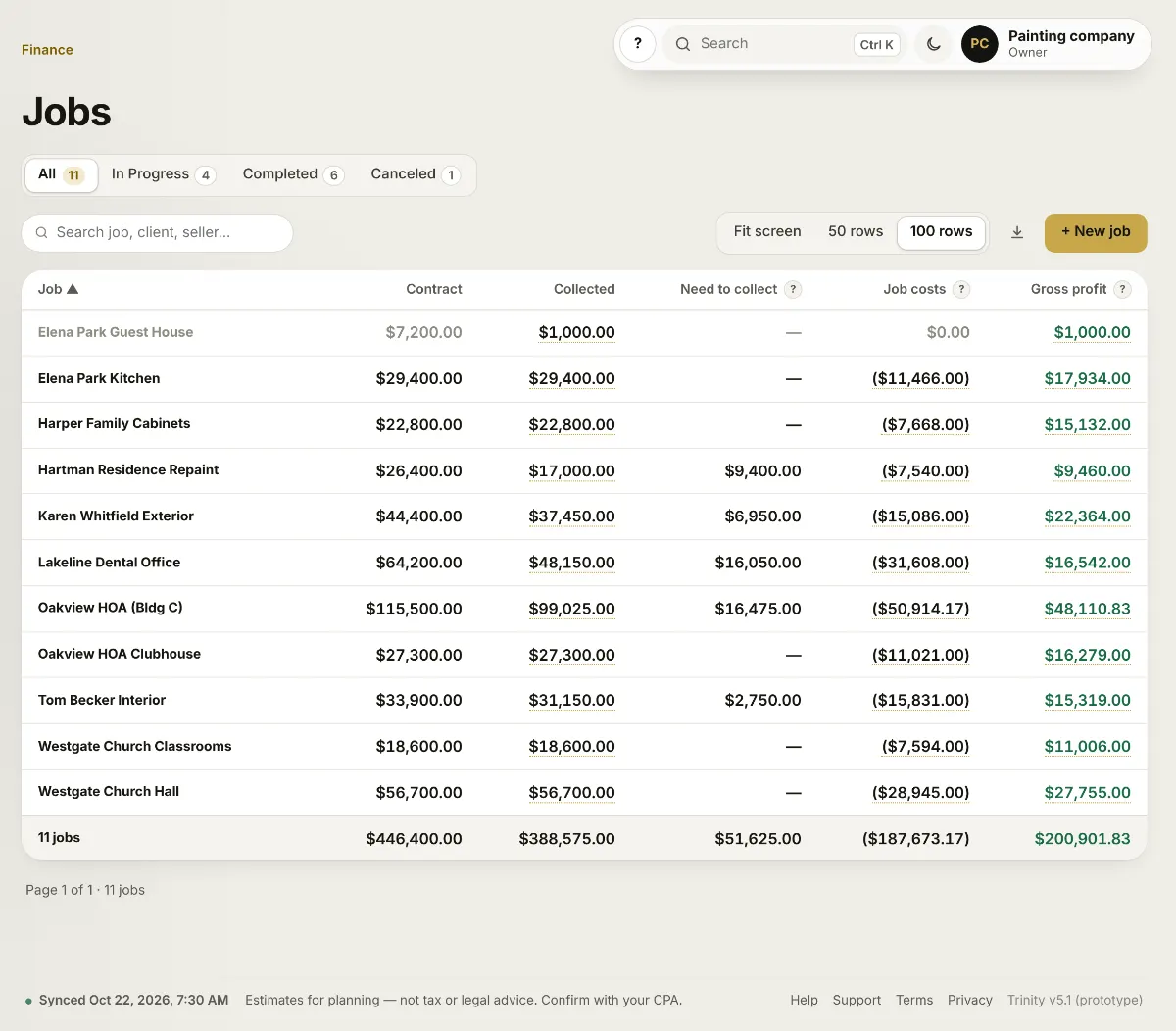
app.trinity.ceo / Jobs
Trinity Jobs: contract, collected, still to collect, job costs and gross profit for every job. Example data.
Every job with its contract, money collected, job costs and gross profit. Real Trinity screen, example data.
Trinity Money Owed: what you owe, what is owed to you and what is still to collect from jobs. Example data.
Money OwedWho owes you, and what you owe
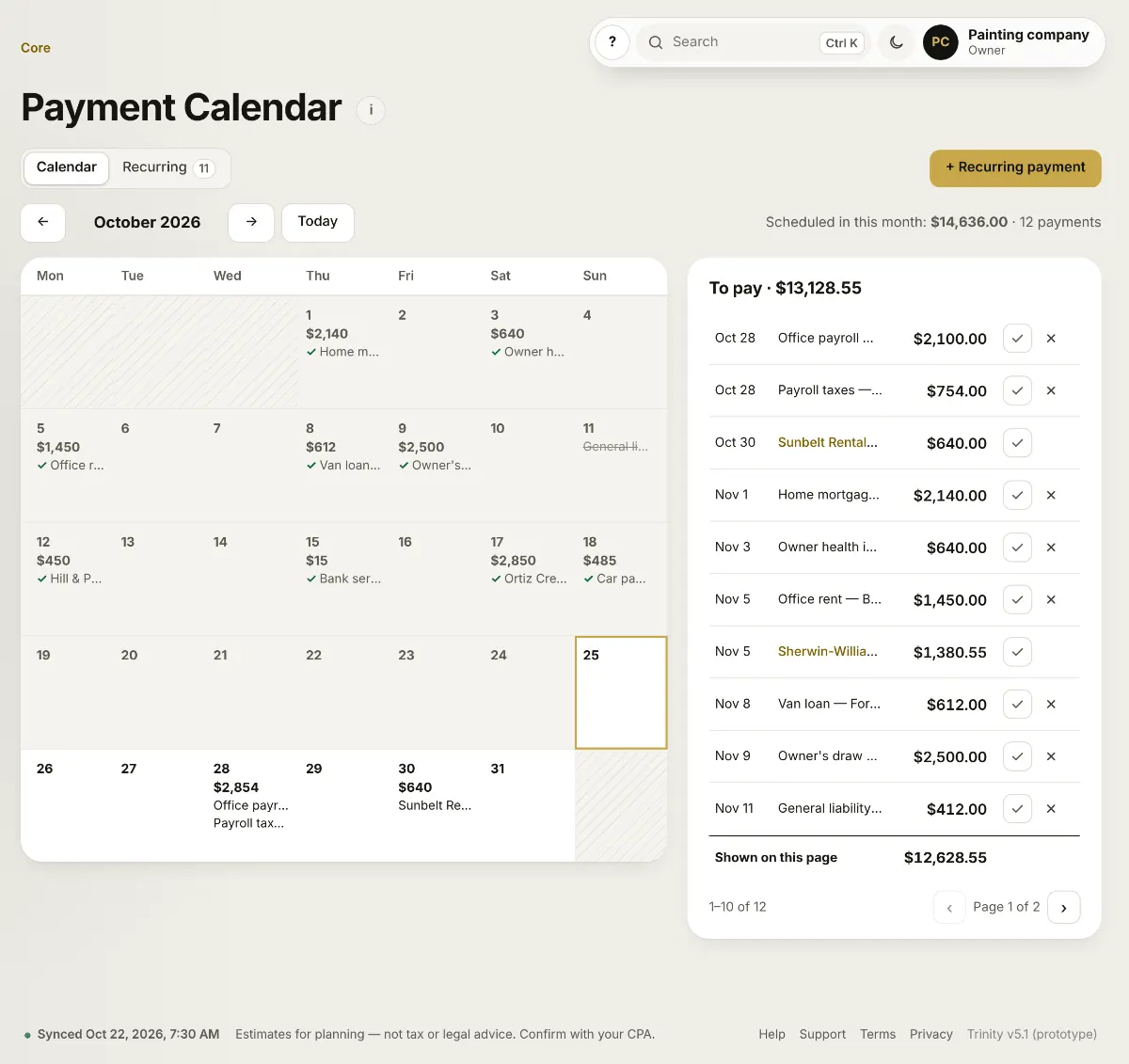
Trinity Payment Calendar: every payment due this month on one calendar. Example data.
Payment CalendarEvery payment due, on one calendar
Trinity Transactions: every bank and card line with its category, job and contact. Example data.
TransactionsEvery bank line sorted to a job

Here is what you get inside Trinity:

  • How to see the profit on every job (so you can stop taking jobs that lose money)Inside: Jobs
  • How to compare the planned cost of a job with what you really spent (so you catch overruns early)Inside: Jobs
  • How to read a monthly profit and loss in plain words (so you know if the company made money)Inside: Profit & Loss
  • How to separate job costs from overhead (so you see your real margin)Inside: Profit & Loss
  • How to see where cash went: jobs, loans, equipment and owner draws (so you stop mixing them up)Inside: Cash Flow
  • How to see what you own and what you owe on one page (so you know what the company is worth)Inside: Balance Sheet
  • How to estimate taxes as you go (so April is not a surprise)Inside: Taxes
  • How to track deductions in the right year (so your CPA has what they need)Inside: Taxes
  • How to see who owes you and for how long (so you chase the right invoice first)Inside: Money Owed
  • How to see what you owe suppliers (so you pay on time without guessing)Inside: Money Owed
  • How to see every payment due on one calendar (so payroll Friday never sneaks up on you)Inside: Payment Calendar
  • How to split loan payments into interest and principal (so your profit is right)Inside: Loans
  • How to depreciate trucks and equipment on schedule (so your books match reality)Inside: Assets
  • How to set a rule once and let matching transactions sort themselves (so the books stay clean without you)Inside: Auto-sort Rules
  • How to split one bank payment across several jobs or categories (so every dollar lands in the right place)
  • How to clear one short list of questions instead of a pile of receipts (so it takes minutes, not evenings)Inside: Needs Review
  • How to see how many months of fixed costs your cash covers (so you know your runway)Inside: Health Signals
  • How to know when overhead is getting heavy for current sales (so you act before it hurts)
  • How to know if you take out more than the business makes (so owner draws stay healthy)
  • How to watch credit card balances (so debt does not grow quietly)
  • How to check debt against equity (so you know if the company runs on borrowed money)
  • How to match ad leads to the jobs you won (so you know which channel pays)Inside: Advertising
  • How to give your bookkeeper, office manager or CPA access by role (so everyone sees only what they need)Inside: Team and Roles

Included with every plan

Plus, two things you don't pay extra for.

Custom financial setup

We connect your accounts, build your chart of accounts and set your auto-sort rules with you. No setup fee on any plan.

A free 30-minute discovery call

Before you pay anything, we look at how you track money today and tell you honestly whether Trinity fits.

No contract

Here is exactly how it works.

Trinity is month to month. There is no long-term contract.

If it is not for you, email [email protected] and cancel any time. Cancellation takes effect at the end of your current billing period.

Monthly plans are not refundable, including for the current month. If you cancel, you keep access until the end of that month.

Yearly plans come with a full refund in the first 30 days. After that, you keep access until the end of the paid year.

And before you pay anything, you get a free 30-minute call, so you know exactly what you are buying.

Questions

Straight answers.

Is Trinity a CPA firm?

No. Trinity does not file tax returns or give tax advice. Our tax figures are estimates for planning. Your CPA makes the final decision, and you can give them access to Trinity.

Who is Trinity for?

Roofing and other contractor companies with one legal owner: sole proprietors, single-member LLCs and S-Corps with one shareholder. Employees and subcontractors are fine. Core fits a simpler sole proprietor or single-member LLC, and Scale fits an S-Corp or an LLC moving to one with several jobs at once. For larger companies we put together a custom plan.

We have two owners. Can we use Trinity?

Not yet. Trinity works with companies that have one legal owner: sole proprietors, single-member LLCs and S-Corps with one shareholder. Employees and subcontractors are fine. Companies with two or more owners, such as partnerships and multi-member LLCs, are not supported yet.

Do I have to do the bookkeeping?

No. We set it up and our team checks your transactions every week. You answer short questions about transactions we cannot identify on our own.

How fast will I see my numbers?

Our goal is that within 30 days you know which jobs made money and what to set aside for taxes. It depends on how quickly your accounts are connected and your questions are answered.

Is there a contract?

No. Plans are month to month and you can cancel any time. You can also pay yearly. Yearly plans come with a full refund in the first 30 days.

Can my bookkeeper or CPA see it?

Yes. You can invite people and give each one a role, so they see only what they need.

Do you have cash flow forecasting?

Yes. On every plan, Trinity forecasts your cash 30, 60 and 90 days ahead from upcoming bills, recurring payments, money still to collect from jobs and taxes, and flags the lowest point.

Pricing

Pick the plan that fits your company.

Every plan includes the Trinity platform, custom financial setup and a team that checks your books every week.

Core

For sole proprietors and single-member LLCs with a simpler setup.

$800/ month

Billed monthly

Book my free call
  • Cash Flow, P&L, Balance Sheet, Jobs and Taxes, full access
  • Profit per job: planned vs actual costs and margin
  • Bank account connections
  • Auto-sort rules set up at the start
  • Weekly transaction monitoring
  • Cash flow forecast: 30, 60 and 90 days
  • Quarterly tax estimates: how much to set aside
  • Year-end data package for your CPA
  • Email support
Recommended

Scale

For S-Corps, or LLCs moving to an S-Corp, running several jobs at once.

$1,400/ month

Billed monthly

Book my free call
  • Everything in Core
  • Bi-weekly financial sessions with an advisor
  • S-Corp support: owner salary (W-2), K-1, and LLC-to-S-Corp transition mid-year
  • S-Corp savings estimate to review with your CPA
  • Quarterly data packages for your CPA
  • Priority support

Larger company, or need reports for your bank? Tell us what you need and we will put together a custom plan.

A full-time in-house accountant costs roughly $4,000 to $6,000 a month in salary alone (our estimate). Trinity starts at $800 a month, with setup included.

Free discovery call first. No setup fee. Month to month, cancel any time.

Your call

You have three options.

Option 1: Hire a full-time accountant.

Roughly $4,000 to $6,000 a month in salary (our estimate), plus the time it takes to hire and train them.

Option 2: Keep things as they are.

Read the bank balance during the year, and review the numbers with your accountant in April.

Option 3: Book a free 30-minute call.

Trinity starts at $800 a month, setup included, no contract. Your books get checked every week from the start.

Book my free 30-minute call

Free call. No setup fee. Month to month, cancel any time.

See you on the call,

Raim Yestayev
Founder, Trinity

P.S. If you only read the bottom of the page: Trinity is a finance platform plus a team that keeps your books clean every week. It starts at $800 a month, setup is included, there is no contract, and the first step is a free 30-minute call.